You're lying in bed, mind racing. The clock ticks past midnight, then 1 AM, then 2. Sleep feels like a distant country you can't get a visa to enter. I've been there, staring at the ceiling, calculating how many hours of rest I'd get if I fell asleep right now. It's miserable. Then I learned about the 120 second military sleep method. Not from a fancy sleep clinic, but from an old friend who served as a Navy pilot. He said they taught it in survival school because your life could depend on catching sleep in a noisy cockpit or a makeshift bunk. The claim sounds outrageous: fall asleep in two minutes or less, anywhere, under any conditions. But after digging into the technique and practicing it myself for months, I can tell you it's less about magic and more about a systematic shutdown of your nervous system. It works, but only if you understand the subtle mechanics most guides gloss over.
What You'll Learn Inside
- Where This 2-Minute Sleep Trick Really Came From
- The Exact 120-Second Military Sleep Protocol, Decoded
- The Science Behind Forcing Your Body to Sleep
- Why It Fails for Most People (And How to Fix It)
- Making the Military Method Work in Your Civilian Bed
- Your Top Questions on the 120-Second Method, Answered
Where This 2-Minute Sleep Trick Really Came From
The story usually points to a U.S. Navy Pre-Flight School manual from World War II, designed to help pilots decompress and sleep under extreme stress. While the exact origins are a bit hazy (military training evolves), the core principles are grounded in legitimate relaxation techniques used in sports psychology and clinical settings for decades. It’s less a “secret hack” and more a structured form of progressive muscle relaxation (PMR) combined with controlled breathing and mental imagery. The military context is key—it wasn't developed for comfort but for operational necessity. When you're in a combat zone, sleep is a tactical resource, not a luxury. This mindset shift is the first thing civilians need to borrow: stop trying to “drift off” and start executing a deliberate procedure.
The Exact 120-Second Military Sleep Protocol, Decoded
Most articles list the steps but miss the nuance. Here’s the breakdown, with the details most people skip.
Phase 1: The 60-Second Body Reset (0-60 seconds)
Lie flat on your back, arms slightly away from your body, palms up. This open posture signals safety to your brain.
Step 1: The Face (10-15 seconds). Close your eyes. Breathe slowly and evenly. Now, focus all your attention on relaxing the muscles in your face—forehead, eyelids, jaw, tongue, cheeks. Imagine them melting into your pillow. A common mistake is just thinking “relax face.” Be specific. Mentally scan: “Smooth the forehead. Let the eyelids go heavy. Unclench the back teeth. Let the tongue rest soft at the bottom of the mouth.” Feel the weight.
Step 2: The Upper Body (20-25 seconds). On an exhale, let the relaxation drip down. Drop your shoulders as far away from your ears as possible. Feel your upper back sink into the mattress. Relax your arms, from biceps to forearms to fingers. Consciously release any tension in your hands. People hold stress here without realizing it.
Step 3: The Lower Body (20-25 seconds). Move down to your legs. Release your thighs, then your calves. Let your knees fall outward slightly. Finally, focus on your feet and ankles. Mentally command them to go limp. The goal is to achieve a sensation of heaviness, as if your body is merging with the bed.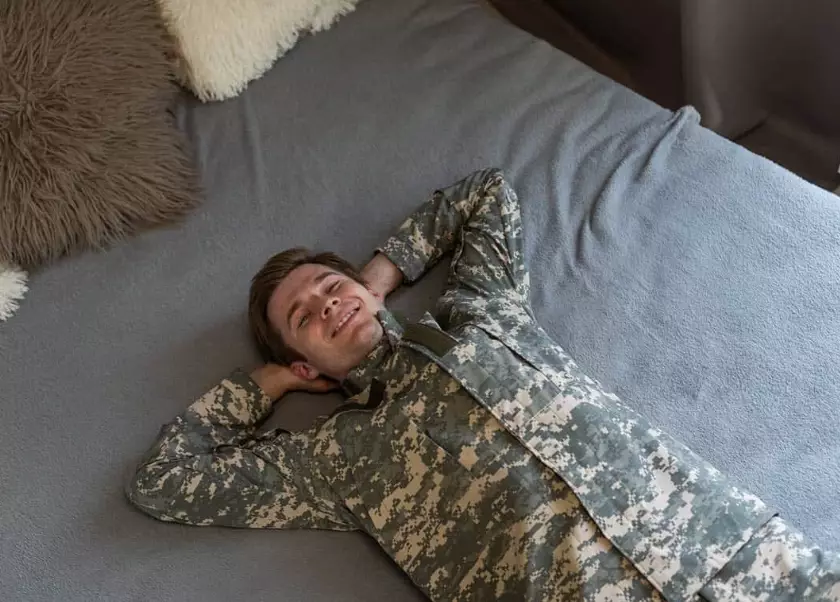
Phase 2: The 60-Second Mind Dump (60-120 seconds)
This is where 90% of people fail. You've quieted the body, now you must quiet the “cognitive chatter.”
Option A: The 10-Second Mental Image (The Classic). Picture yourself lying in a canoe on a calm, dark lake. There’s nothing but a clear, starry sky above you. Hold that single, peaceful, static image. When thoughts intrude (and they will), gently acknowledge them and return to the canoe and the sky. Don't get frustrated; just redirect. The image is boring by design.
Option B: The “Breathe and Repeat” Mantra (For Overthinkers). If the canoe feels silly or doesn't stick, try this. Inhale slowly for a count of 4, thinking “in… two… three… four.” Exhale slowly for a count of 6, thinking “out… two… three… four… five… six.” Pair each exhale with a silent, meaningless word like “sleep” or “down.” The longer exhale activates the parasympathetic nervous system. The counting occupies your verbal mind just enough.
The critical point is to not engage with any thought that arises. You're a bouncer at the club of your mind. See a thought about tomorrow's meeting? “Not tonight.” A replay of an awkward conversation? “Sorry, you're not on the list.” Gently escort it out and return to your chosen focus.
The Science Behind Forcing Your Body to Sleep
This isn't just wishful thinking. The method leverages well-established physiological principles.
First, the progressive muscle relaxation component (Phase 1) creates a direct feedback loop. By consciously releasing tension, you send signals via your somatic nervous system to your brain that the danger (or stress) is over. This lowers cortisol and adrenaline. Studies on PMR show it can significantly reduce physiological arousal, a primary barrier to sleep onset.
Second, the controlled breathing (especially the 4-6 pattern in Option B) stimulates the vagus nerve. This is the main highway of your parasympathetic nervous system—your “rest and digest” mode. The longer exhale increases vagal tone, slowing your heart rate and lowering blood pressure, mirroring the state of early sleep.
Third, the mental focus exercise (Phase 2) is a form of cognitive distraction. It prevents you from engaging in the “problem-solving” or “worry” loops that keep the prefrontal cortex active. By giving your busy mind a simple, repetitive, and emotionally neutral task (holding an image or counting breaths), you induce a state of “cognitive quiet.” This is essentially a bridge into the hypnagogic state, the transitional period between wakefulness and sleep.
In short, the method manually flips the switches your body should flip automatically but often doesn't due to modern stress.
Why It Fails for Most People (And How to Fix It)
People try this once, get frustrated, and declare it a myth. Here are the silent killers of the technique, based on coaching others through it.
| Common Mistake | Why It Happens | The Fix |
|---|---|---|
| Rushing Phase 1 | You treat the body scan as a checklist, not a sensory experience. You think “okay, face done, shoulders done” without actually feeling the release. | Spend a full 5-7 seconds on each major muscle group. Ask: “Do I still feel holding here?” Breathe into the tense spot on the inhale, imagine melting it on the exhale. |
| Fighting Thoughts in Phase 2 | You get angry when your mind wanders. “Ugh, I'm thinking about work again! I failed!” This frustration is more stimulating than the original thought. | Expect the thoughts. Your job isn't to create a blank mind—that's impossible. Your job is to gently disengage. Treat thoughts like clouds drifting by; notice them, then return to your anchor (canoe or breath). No judgment. |
| Wrong Physical Setup | You try it in a chair, or with your neck crooked, or right after staring at a bright screen. Physical discomfort or light exposure (blue light) directly signals “wakefulness” to your brain. | Do it in bed, in sleep-ready conditions. Ensure your pillow supports your neck neutrally. Dim the lights 20 minutes prior. The method is the final step, not the entire routine. |
| Expecting Instant Mastery | You're learning a skill. A soldier practices this for weeks in training. You wouldn't expect to play a piano piece perfectly on the first try. | Commit to a 10-night practice run. Don't time yourself. Just follow the process faithfully. Your goal for Night 1 isn't sleep, it's completing the sequence. Speed is a byproduct of familiarity. |
The biggest unspoken truth? The first step most people get wrong is actually the breathing. They hold their breath or breathe too shallowly during the muscle relaxation. Your breath is the conductor of the entire orchestra. If it's tense, everything else stays tense.
Making the Military Method Work in Your Civilian Bed
You're not in a bunker. You have a partner, a phone, and a mind full of non-combat stressors. Here’s how to adapt.
For Side Sleepers: The classic posture is on your back. If you can't sleep on your back, modify. After the facial relaxation, focus on the side you're lying on. Relax the shoulder you're resting on, imagining it sinking down. Relax the hip and leg on that side. The principle is the same: systematic release of the muscles in contact with the bed.
With a Partner: Communicate. Tell them you're practicing a relaxation technique and need a few minutes of quiet. Often, just doing the breathing and facial relaxation silently is enough to trigger sleep before they even notice.
For Racing Minds (The “To-Do List” Brain): If Option A and B fail because urgent thoughts bombard you, add a pre-game step. Keep a notepad by the bed. 30 minutes before bed, brain-dump every thought, task, or worry onto the paper. Close it. Tell yourself, “It’s on the paper, my brain doesn't need to hold it tonight.” This externalizes the cognitive load, making Phase 2 much easier.
Integrate with Sleep Hygiene: This method is not a substitute for good habits. It's the capstone. Combine it with a consistent wake-up time, limited evening caffeine, and a dark, cool room. The National Sleep Foundation has excellent resources on building this foundation. The military method is your “on” switch, but sleep hygiene ensures the power is connected.
Your Top Questions on the 120-Second Method, Answered
The 120 second military sleep method isn't a gimmick. It's a disciplined practice of relinquishing control—over your muscles, your breath, and finally, the endless chatter of your thoughts. It won't work like a light switch on day one. But if you approach it as a skill to be honed, a consistent pre-sleep ritual, it can transform those agonizing hours of wakefulness into a predictable, quiet passage into sleep. Start tonight. Not with the goal of sleeping in two minutes, but with the goal of simply following the steps. The sleep will come find you.
Reader Comments